

Are you a beauty brand owner trying to understand why cosmetic tube pricing varies so much from one supplier to another? Or why a “$0.25 tube” suddenly becomes $0.55 after printing, shipping, and MOQ adjustments? You’re not alone.
Many small and mid-size brands struggle to calculate their true packaging cost. They often focus only on the quoted “per-tube price,” missing the hidden fees, design charges, printing complexity, logistics, and regulatory requirements that silently add up.
This guide will help you decode cosmetic tube cost, tube packaging pricing, cosmetic packaging cost structure, and all related cost factors — written in simple, clear English so any startup founder or mid-size brand owner can follow easily.
In this guide, you will learn:
- What makes up a cosmetic tube and how each part affects the cost
- How materials, sustainability choices, and manufacturing methods impact pricing
- Why MOQs matter and how to use them to reduce unit cost
- How customization (printing, shapes, caps) changes cost
- The hidden and indirect costs most brand owners forget
- How to calculate your TRUE cost per tube
- Common sourcing mistakes and how to avoid them
- Smart negotiation and long-term cost optimization strategies
Let’s begin by understanding the core structure of a cosmetic tube.
The Anatomy of a Cosmetic Tube: Understanding Its Core Components and Their Influence on Cost
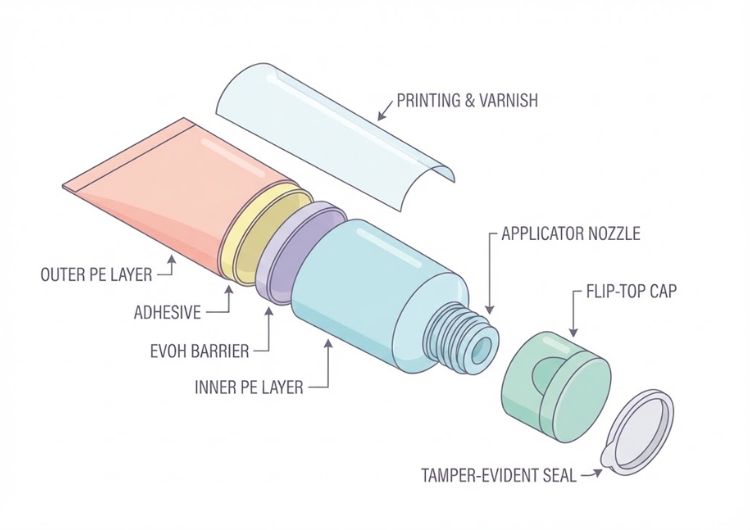
Cosmetic tubes look simple—but the cost structure behind them is surprisingly complex. Each tube contains several parts, and every part directly impacts the final price.
Before you compare quotes, you must understand what a cosmetic tube is made of. A tube typically includes:
- The tube body (single-layer, multi-layer, or laminated)
- The cap or closure
- The applicator (if included)
- Decoration and printing
- Optional inner layers or barrier materials
Each component raises or lowers your price depending on complexity, material type, and design requirements.
The Tube Body: Material Choices and Layering
The tube body is the heart of the packaging. It determines durability, flexibility, sustainability, and compatibility with your product. It also accounts for a large portion of your cosmetic tube pricing.
Cheaper materials → lower cost
Basic PE (polyethylene) is the most affordable and widely used option.
Premium or multi-layer materials → higher cost
If your formula is sensitive (e.g., vitamin C, retinol, SPF), you may need barrier layers, EVOH, or multi-layer laminate. These provide better protection but cost more.
Want to explore material choices?
👉 See all cosmetic tube materials
When comparing quotes, always check:
- Is the tube single-layer or multi-layer?
- Is the supplier using virgin materials or PCR (recycled content)?
- What thickness is the tube?
These directly affect cost.
Caps, Closures, and Applicators: Functionality Meets Price Point
Caps are the second biggest cost driver after the tube body.
Here is what you need to know:
- Screw caps → cheapest
- Flip-top caps → moderate price increase
- Metal caps or weighted caps → higher cost
- Special applicators (brush, sponge, roller) → significant extra cost
- Airless systems → highest price category
A basic lotion tube may use a standard cap.
A premium eye cream tube may use a metal applicator.
Same tube body — totally different cost.
Explore application types:
👉 Cosmetic tube applications
Printing and Decoration: Where Visual Appeal Adds Value (and Cost)
Printing and decoration can double the price of a simple tube.
Here’s a quick cost hierarchy:
- 1–2 color basic printing → cheapest
- 4+ color printing → moderate cost
- Metallic inks, gradients, or full-wrap artwork → higher
- Hot stamping, embossing, debossing → premium
- Soft-touch or matte varnish → premium
- Holographic or custom foil → highest tier
Ask yourself:
Does each decoration step increase the perceived retail value?
Or just increase cost?
If your product is positioned as premium, advanced decoration makes sense.
If it’s mass-market or price-sensitive, simpler may be better.
Core Cost Drivers: Materials & Manufacturing Processes
Now that you know the components, let’s examine the biggest cost drivers in tube packaging pricing. These include materials, sustainability choices, and how the tubes are manufactured.
Material Selection: From Standard Plastics to Sustainable Solutions
The biggest cost difference comes from the material your tube is made from.
Standard plastic tubes (PE)
- Lowest cost
- Excellent for most lotions, creams, gels
- Suitable for mass-market and mid-range products
Laminated tubes (ABL/PBL)
- Better barrier against oxygen and formula oxidation
- Common for sensitive skincare
- Higher cost due to multiple layers
PCR / PCR-PE recycled tubes
- Eco-friendly option
- Often higher cost due to material sourcing
- Adds sustainability marketing value
- Increasingly popular among clean beauty brands
Bio-based or biodegradable tubes
- Limited availability
- Highest price category
- Best for sustainability-focused brands
If you want sustainability without blowing your budget, a PCR-mix tube (30–50% PCR) may be a smart middle-ground.
Manufacturing Methods: How Tubes Are Made and What It Costs
Manufacturing complexity = higher cost.
Here’s the breakdown:
Simplest: Extruded PE tubes
- Cost-effective
- Ideal for lotions, hand creams, body products
- Higher production efficiency = good pricing
Explore related product types:
👉 Lotion tubes
Moderate complexity: Laminated tubes
- Multiple material layers fused together
- Better barrier
- Requires more sophisticated production
Complex: Aluminum-plastic hybrid tubes / premium tubes
- Higher tooling cost
- Requires more QC
- Premium positioning
Highest complexity: Airless tubes
- Multi-part structures
- Tight QC standards
- Premium cost, premium feel
Manufacturing method matters because suppliers must adjust machines, molds, and QC processes — and all these steps add cost.
Printing and Finishing Techniques: Elevating Appearance and Price
Decoration is often where brands overspend without realizing it.
Here’s a cost breakdown:
Lower cost decorations:
- Simple CMYK printing
- Small logos or minimal graphics
- Basic glossy finish
Medium cost decorations:
- Full-wrap artwork
- Gradient backgrounds
- Matte finishes
- High-resolution photography
High cost decorations:
- Foil stamping (gold, silver, rose gold)
- Embossing / debossing
- Spot UV
- Holographic foil
Decoration choices affect:
- MOQ
- Printing setup fees
- Lead time
- Color matching time
- QC difficulty
Sometimes reducing one printing pass saves you thousands.
The Volume Factor: Minimum Order Quantities (MOQs) and Economies of Scale

MOQ may be the single most important factor that beginners misunderstand about cosmetic tube cost.
Understanding MOQs: Why Manufacturers Set Them
Manufacturers set MOQs for three reasons:
- Machine setup cost – turning on machines, cleaning, calibration
- Labor and overhead – same regardless of order size
- Material waste – low orders result in expensive waste
If a supplier tells you the MOQ is 5,000 tubes, it’s not because they dislike small brands — it’s because small orders cost them time and money.
Learn how custom orders work:
👉 Custom cosmetic tube manufacturing
The Price Per Unit Advantage: How Higher Volumes Reduce Costs
Here’s the basic math:
- Order 5,000 tubes → high cost per unit
- Order 10,000 tubes → 5–10% lower cost
- Order 50,000 tubes → best price per unit
A supplier’s fixed cost is spread across more units, which lowers your per-tube price significantly.
This is why brands with high sales volumes can afford nicer tubes — because their unit cost is low enough to allow premium decoration or higher-grade materials.
Strategic Planning for Small Businesses: Navigating MOQs Effectively
If you are a startup or small brand:
- Group several SKUs into one production
- Use standard shapes or caps for all products
- Start with simple printing
- Move to premium decoration later
- Avoid custom tooling until you scale
- Ask supplier for a “trial MOQ” for your first launch
This keeps cost manageable while still giving you professional packaging.
Design & Customization: Where Aesthetics and Functionality Meet Expense

Customization is powerful for branding — but it’s also one of the most expensive parts of your packaging project. Let’s break down how different customization choices affect cosmetic tube pricing.
Custom Tube Shapes and Sizes: Standing Out While Managing Budget
Custom tube shapes require custom molds, which can cost hundreds or thousands of dollars.
- Standard tubes → no tooling cost
- Slightly modified sizes → small mold fee
- Unique shapes → expensive tooling + longer lead time
- Odd capacities (22ml, 37ml, etc.) → higher cost
If you’re a startup, stay with standard sizes.
When you grow, customize.
Unique Cap and Applicator Designs: Innovation and Its Cost Implications
Caps and applicators often cost more than the tube itself.
Examples:
- Metal cooling applicators (eye cream)
- Sponge tip applicators (BB cream)
- Brush tips (concealer, lip gloss)
- Roller balls (serums)
These require:
- More materials
- More parts
- Additional assembly
- Stricter QC
Explore relevant product category:
👉 Cream tubes
If your formula requires precision application or a premium feel, the added cost may be worth it.
Artwork Complexity and Color Count: Visuals that Influence Cost
Artwork complexity affects:
- Printing setup
- Color calibration
- Plate-making cost
- Scrap rate
- QC difficulty
Here’s how cost increases:
- 1–2 color → low
- 3–5 colors → medium
- 6+ colors → high
- Metallic or special color → premium
- Full-body art → highest
Simple designs = best for small brands.
Complex illustrations = suitable for mid-size brands with higher margin.
Prototyping and Samples: Essential Steps in the Design Process
Prototyping can include:
- Digital mockups
- 3D models
- Color proofs
- Sample tubes (with or without printing)
It adds small upfront cost but avoids huge mistakes later.
Never skip sampling before mass production.
Beyond the Tube: Hidden and Indirect Costs Brand Owners Must Consider

This is where many brand owners miscalculate total packaging cost.
Hidden costs can increase your “real price” by 20–50%.
Artwork and Graphic Design Fees: The Cost of Your Brand’s Visual Identity
Designing your artwork includes:
- Logo placement
- Typography
- Color matching
- Label requirements
- Ingredient layout
If you hire a freelance designer, agency, or in-house designer, include these fees in your cost calculation.
Quality Control and Testing: Ensuring Product Integrity and Consumer Safety
Testing and QC may include:
- Drop tests
- Compression tests
- Seal integrity tests
- Compatibility with formula
- Heat and cold testing
Regulated markets require strict safety measures:
External reference → https://ec.europa.eu/growth/sectors/cosmetics/
Skipping QC = risk of leaks, defects, or product recalls.
Freight, Shipping, and Logistics: Getting Your Tubes from Manufacturer to Filler
Costs include:
- Sea freight or air freight
- Carton size, weight, volume
- Import duty
- Packaging waste fees (for EU markets)
- Inland transportation
These can exceed the cost of the tubes themselves if your order is small.
Regulatory Compliance and Certifications: Navigating the Legal Landscape
Examples:
- Material safety certification
- FDA compliance for packaging
(Reference: https://www.fda.gov/cosmetics/cosmetic-products) - REACH compliance (EU)
- Labeling rules
Compliance adds cost but is critical for legal sale.
Contract Filling and Assembly Services: The Cost of Getting Your Product into the Tube
You may need:
- Filling cost
- Sealing and capping cost
- Lot coding
- Outer box or carton
- Kit assembly
Many small brands forget to include this in their cost estimate.
Strategic Pricing for Brand Owners: Maximizing Value and Profitability
Now let’s talk strategy.
Understanding cost drivers is good — but using that knowledge smartly is even better.
Calculating Your True Unit Cost: A Comprehensive Formula
Use this formula:
True Unit Cost =
Tube Cost
+ Cap Cost
+ Printing Cost
+ Artwork Cost (per unit)
+ QC Cost (per unit)
+ Freight & Duty (per unit)
+ Filling Cost (per unit)
+ Overhead & Misc (per unit)
This gives the REAL cost of making your finished product.
Balancing Cost with Brand Perception and Market Positioning
Packaging influences:
- Brand image
- Customer expectations
- Retail price
- Perceived value
Match packaging investment to your target market:
- Budget brands → simple tubes
- Mid-market skincare → moderate decoration
- Premium beauty → higher-end materials + decoration
Effective Negotiation Strategies with Suppliers
You can negotiate better if you:
- Increase volume
- Order fewer SKUs
- Simplify printing
- Standardize caps
- Commit to long-term production
Suppliers support brands that show growth potential.
Long-Term Cost Reduction and Optimization Strategies
To save money long-term:
- Reuse molds
- Use similar tube sizes
- Standardize decoration elements
- Increase order volume
- Switch to sea freight instead of air
- Build long-term supplier relationships
This reduces cost and stabilizes your supply chain.
Common Pitfalls and How to Avoid Them in Cosmetic Tube Sourcing

Mistakes cost money. Here are the top pitfalls to avoid.
Underestimating Hidden Costs: The Budget Buster
Never assume tube price = total cost.
Visit our detailed guide:
👉 Skincare packaging cost breakdown
Ignoring Minimum Order Quantities (MOQs): Trapping Your Cash
Low orders = high cost + slow delivery.
Learn more about custom manufacturing:
👉 Custom cosmetic tube manufacturing
Sacrificing Quality for Price: The Risk to Brand Reputation
Cheap packaging → weak brand trust.
Explore stable quality applications:
👉 Makeup tube packaging
Lack of Clear Communication with Suppliers
Avoid mistakes by sending clear specs, artwork, and references.
Failing to Plan for Growth or Demand Fluctuations
Plan 2–3 purchasing cycles ahead to avoid out-of-stock situations.
Conclusion: Empowering Your Brand Through Cost Clarity

You now understand the full cosmetic tube pricing model — including materials, MOQs, decoration, sustainability, shipping, and hidden costs.
Summary: Key Takeaways
- Cosmetic tube pricing depends on materials, design, and manufacturing
- MOQs heavily influence per-unit cost
- Decoration and printing can double your cost
- Hidden fees (shipping, QC, duty, filling) matter
- Planning ahead saves money and prevents delays
Next Steps for Different Brand Types
For startup brands
- Choose standard tubes
- Start with simple printing
- Try small-volume production
- Explore material options:
👉 All materials
For mid-size brands
- Move toward semi-custom or custom tubes
- Improve decoration for brand value
- Negotiate long-term pricing with suppliers
For scaling brands
- Invest in custom tooling
- Increase order volume
- Switch to sustainable tubes for brand positioning
- Consider one-stop solutions:
👉 One-stop packaging solutions
Ready to get accurate cosmetic tube pricing and expert support tailored to your brand?
Contact our team anytime for custom quotes and professional guidance:
👉 Contact Luxetubes , We’re here to help you build beautiful, cost-effective packaging that grows your brand.
