
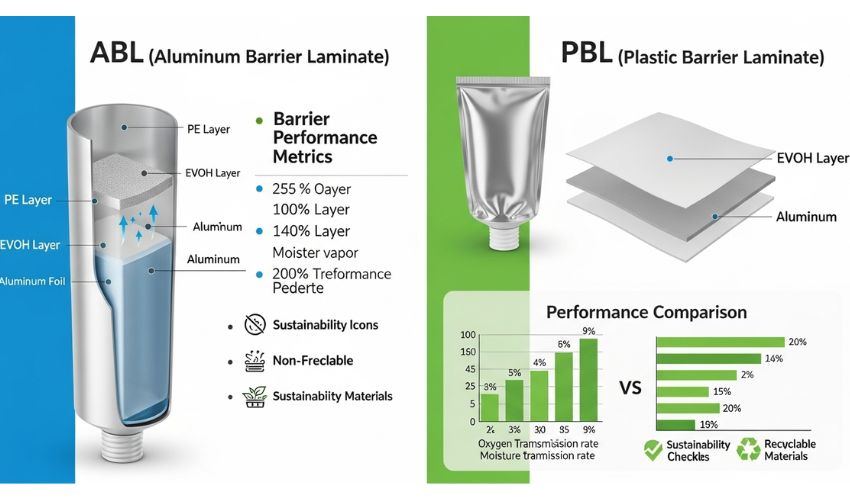
Stellen Sie sich vor, Sie bringen eine bahnbrechende Hautpflegelinie auf den Markt und müssen dann zusehen, wie Ihr Produkt an Qualität verliert, weil die Verpackung unzureichend ist. Wenn es um den Schutz Ihrer Formel geht, Wahl zwischen ABL- und PBL-Laminattuben ist eine entscheidende Entscheidung, die keine Kosmetikmarke übersehen sollte.
Beide bieten mehrschichtigen Schutz, unterscheiden sich jedoch in der Barrierestärke, Recyclingfähigkeit, Kosten und Designflexibilität – Faktoren, die über den Erfolg Ihres Produkts entscheiden können. In diesem Leitfaden klären wir die Verwirrung auf, klären die Hauptunterschiede auf und helfen Ihnen bei der Auswahl der richtigen Tube, die den Anforderungen und Nachhaltigkeitszielen Ihrer Formel entspricht. Sind Sie bereit, eine fundierte Verpackungsentscheidung zu treffen, die Ihre Marke von anderen abhebt? Lass uns eintauchen!
Was sind Laminattuben und warum sind sie für Kosmetika wichtig?
Haben Sie sich jemals gefragt, warum Ihre Lieblingskosmetik in diesen schlanken, flexiblen Tuben erhältlich ist? Laminatrohre sind das Geheimnis hinter dem Schutz und der Konservierung Ihrer Schönheitsprodukte. Bei diesen Tuben handelt es sich um mehrschichtige Hybride, die durch die Kombination verschiedener Kunststoffe mit Barrierematerialien wie Aluminiumfolie oder EVOH hergestellt werden und im Vergleich zu herkömmlichen Tuben einen besseren Schutz bieten Aluminium oder einfache Rohre aus Polyethylen (PE).
In der Kosmetik spielen Laminattuben eine entscheidende Rolle. Sie schützen Wirkstoffe vor schädlichem Sauerstoff, Licht und Feuchtigkeit, die die Formeln mit der Zeit zersetzen können. Dieser Schutz sorgt dafür, dass Ihre Hautpflege und Ihr Make-up länger frisch und wirksam bleiben. Darüber hinaus unterstützen diese Tuben dank des hochauflösenden Drucks direkt auf der Oberfläche ein lebendiges, detailliertes Branding – ein Gewinn sowohl für Vermarkter als auch für Verbraucher, die Wert auf Ästhetik legen.
Die Nachfrage nach Laminattuben steigt schnell, angetrieben durch die Clean-Beauty-Bewegung und strengere Branchenvorschriften, die eine bessere Konservierung und sicherere Verpackung erfordern. Marken wünschen sich Verpackungen, die nicht nur Leistung erbringen, sondern auch den wachsenden Erwartungen der Verbraucher an Nachhaltigkeit und Qualität entsprechen.
Bei LuxetubeSeit über 10 Jahren stehen wir an der Spitze dieser Innovation und produzieren jährlich mehr als 10 Millionen hochwertige Laminattuben. Unsere Erfahrung hilft Kosmetikmarken dabei, Produkte zu liefern, die länger frisch bleiben und im Regal erstklassig aussehen. Wenn Sie nach Upgrades für Kosmetikverpackungen suchen, sind Laminattuben auf jeden Fall eine Überlegung wert.
Weitere Informationen zu Verpackungsoptionen finden Sie in unseremLaminattuben für Gesichtscreme und entdecken Sie, wie Sie Ihre Kosmetiklinie mit langlebigen, anpassbaren Tuben aufwerten können.
Verständnis der Strukturstärken und idealen Verwendungsmöglichkeiten von ABL-Laminatrohren
ABL-Laminattuben (Aluminum Barrier Laminate) haben einen mehrschichtigen Aufbau, der für starken Schutz ausgelegt ist. Sie umfassen typischerweise eine Außen- und Innenschicht aus Polyethylen (PE) für Flexibilität und Abdichtung sowie eine mittlere Barriere aus Aluminiumfolie mit einer Dicke von 9 bis 30 Mikrometern.
Diese Aluminiumschicht ist der Schlüssel zur Blockierung von Sauerstoff, Licht und Feuchtigkeit. Zwischen diesen Schichten befinden sich Klebstoffe, die alles zusammenhalten. Diese Rohre werden häufig durch Präzisionsextrusion mit Schweißnähten hergestellt und zur Qualitätskontrolle und Kosteneffizienz üblicherweise in China hergestellt.
Hauptvorteile von ABL-Röhren
- Überlegene Barriere: Blockiert über 99 % des Sauerstoffs, des Lichts und der Feuchtigkeit, was für empfindliche oder aggressive Kosmetikformeln von entscheidender Bedeutung ist.
- Chemische Beständigkeit: Ideal für Cremes und Gele mit leicht abbaubaren Wirkstoffen.
- Haltbarkeit: Behält seine Form gut, wenn es zusammengedrückt wird, wodurch es benutzerfreundlich und konsistent ist.
- Kostengünstig: Wirtschaftliche Option für Großserienproduktionen ohne Leistungseinbußen.
Mögliche Nachteile
- Begrenzte Recyclingfähigkeit: Gemischte Materialien erschweren das Recycling dieser Röhrchen in Standardanlagen.
- Ästhetische Einschränkungen: Das Aluminium verleiht einen metallischen Glanz, den einige Marken möglicherweise weniger ansprechend finden als Soft-Touch- oder Vollkunststoffoberflächen.
- Fühlen: Weniger weich und flexibel im Vergleich zu Tuben, die nur aus Kunststoff bestehen, was sich bei einigen Produkten auf das Benutzererlebnis auswirken kann.
Nachfolgend finden Sie einen kurzen Überblick über die ABL-Barriereeigenschaften im Vergleich zu anderen Röhrchentypen:
| Eigentum | ABL-Laminatröhren | Kommentare |
|---|---|---|
| Sauerstoffbarriere | >99 % Verstopfung | Hervorragend geeignet für empfindliche Formeln |
| Lichtschranke | Hoch | Schützt UV-empfindliche Inhaltsstoffe |
| Feuchtigkeitsbarriere | Hoch | Verhindert das Austrocknen des Produkts |
| Chemischer Widerstand | Stark | Geeignet für aggressive Wirkstoffe |
| Recyclabalität | Beschränkt | Gemischte Schichten erschweren das Recycling |
Für Marken, die sich mit aktiven, sauerstoffempfindlichen Kosmetika befassen oder Wert auf Kosten und Haltbarkeit legen, bleiben ABL-Laminattuben eine praktische Wahl, die Leistung und Preis in Einklang bringt.
Erkundung der Zusammensetzungsvorteile und besten Anwendungen von PBL-Laminattuben
PBL-Laminattuben bestehen aus Vollkunststoffschichten, die hauptsächlich Polyethylen (PE) mit einer EVOH-Barriere (Ethylenvinylalkohol) und Klebstoffen kombinieren – ohne Aluminiumfolie. Dieses Vollkunststoffdesign macht PBL-Tuben vollständig recycelbar und unterstützt Nachhaltigkeitsziele bei Kosmetikverpackungen. Der Herstellungsprozess nutzt eine nahtlose Extrusion, die glatte Oberflächen und Optionen zur individuellen Anpassung der Opazität und Dicke der EVOH-Barriere an unterschiedliche Produktanforderungen ermöglicht.
Zu den Hauptvorteilen von PBL-Röhren gehören:
- Umweltfreundlich und 100 % recycelbar– Entwickelt, um zu Kreislaufwirtschaftsmodellen zu passen.
- Flexible Gestaltungsmöglichkeiten– Ermöglicht Soft-Touch-Oberflächen und 360-Grad-CMYK-Druck für lebendiges Branding.
- Wirksame Sauerstoff- und Geruchsbarrieren– schützende Formeln, die nicht sehr empfindlich gegenüber Licht oder aggressiven Chemikalien sind.
- Robust und langlebig– ideal für Bio-Seren, Lotionen und Kosmetikprodukte mit milden Formeln.
Zu berücksichtigende mögliche Nachteile:
- Weniger wirksam bei der Blockierung von UV-Licht im Vergleich zu Tuben auf Aluminiumbasis, daher nicht ideal für stark lichtempfindliche Wirkstoffe.
- Höhere Anschaffungskosten im Vergleich zu ABL-Röhren, die jedoch oft durch Umweltvorteile und längerfristige Einsparungen ausgeglichen werden.
PBL-Röhren verfügen außerdem über anerkannte Recycling-Zertifizierungen, was sie zu einer klugen Wahl für Marken macht, die sich auf Nachhaltigkeit konzentrieren. Diese Struktur eignet sich am besten für natürliche und saubere Schönheitsprodukte, die einen guten Sauerstoffschutz ohne das Gewicht von Metallbarrieren erfordern.
Direkter Vergleich von ABL- und PBL-Laminatröhren
Bei der Wahl zwischen ABL- und PBL-Laminattuben ist es wichtig, deren Unterschiede in Bezug auf Barriereschutz, Nachhaltigkeit, Kosten und Benutzererfahrung zu verstehen.
Barriereeigenschaften und Produktschutz
| Besonderheit | ABL-Laminatröhren | PBL-Laminatrohre |
|---|---|---|
| Sauerstoffbarriere | Hervorragend – Blockiert Sauerstoff zu über 99 % | Sehr gut – die EVOH-Barriere widersteht Sauerstoff gut, aber etwas weniger als ABL |
| Lichtschutz | Überlegen – starke Aluminiumfolie | Mäßig – EVOH bietet weniger UV-/Lichtschutz |
| Chemischer Widerstand | Hoch – ideal für aggressive Formeln | Moderat – ideal für weniger aggressive Kosmetikprodukte |
| Wasserdampfsperre | Stark – niedrige WVTR-Werte | Gut – etwas höhere WVTR im Vergleich zu ABL |
Nachhaltigkeit und Recyclingfähigkeit
- ABL-Röhren: Aufgrund der Vermischung von Aluminium- und Kunststoffschichten ist das Recycling eine Herausforderung. Die Folienschicht erschwert den Recyclingprozess in den meisten US-Einrichtungen.
- PBL-Röhren: Entwickelt für die Kreislaufwirtschaft mit 100 % Kunststoffmaterialien, vollständig recycelbar durch gängige lokale Recyclingprogramme.
Kosten, Anpassung und Benutzererfahrung
- Preis: ABL ist in der Regel mit geringeren Vorabkosten verbunden, was es zu einer wirtschaftlichen Wahl für Großaufträge macht.
- Anpassung: PBL bietet überragende Designflexibilität mit lebendigem 360°-CMYK-Druck und Soft-Touch-Oberflächen, die die Attraktivität von Luxusmarken steigern.
- Fühlen: PBL-Röhren sorgen für ein weicheres, erstklassiges Gefühl, während ABL-Röhren funktioneller und langlebiger sind, sich aber weniger „luxuriös“ anfühlen.
Kurzübersicht Vor- und Nachteile
| Aspekt | ABL-Röhren | PBL-Röhren |
|---|---|---|
| Barrierestärke | Hervorragend geeignet für Sauerstoff/Licht/Feuchtigkeit | Hervorragender Sauerstoff, mäßiger Lichtschutz |
| Recyclabalität | Aufgrund gemischter Materialien eingeschränkt | Vollständig recycelbar, umweltfreundlich |
| Kosten | Niedrigere Vorabkosten | Höhere Anschaffungskosten, aber besserer ROI |
| Am besten für | Aggressive Formeln, großes Volumen | Bio-/Naturprodukte, Luxus-Branding |
Beispiel aus der Praxis
Ein Luxetube-Kunde ist kürzlich von ABL- auf PBL-Röhren umgestiegen und konnte eine Steigerung der Recyclingfähigkeit um 20 % feststellen, ohne dass der Produktschutz oder das Erscheinungsbild der Marke beeinträchtigt wurden. Dieser Wechsel unterstützte ihre Clean-Beauty-Positionierung und kam bei umweltbewussten US-Verbrauchern gut an.
Bei der Wahl zwischen ABL- und PBL-Laminattuben kommt es auf das Gleichgewicht zwischen Schutzbedürfnissen, Nachhaltigkeitszieleund Markenerlebnis. Das Fachwissen von Luxetube macht es einfach, die richtige Passform für Ihre Kosmetikprodukte zu finden.
So wählen Sie zwischen ABL und PBL für Ihre Kosmetikprodukte
Die Wahl zwischen ABL- und PBL-Laminattuben hängt von den Anforderungen Ihres Produkts und den Zielen Ihrer Marke ab. Hier ist eine einfache Schritt-für-Schritt-Anleitung, die Ihnen bei der Entscheidung hilft:
1. Bewerten Sie die Empfindlichkeit Ihrer Formel
- Wenn Ihr Produkt sehr empfindlich auf Sauerstoff, Licht oder Feuchtigkeit reagiert – wie medizinische Cremes oder Formeln mit Wirkstoffen – sind ABL-Tuben eine gute Wahl. Ihre Aluminiumbarriere blockiert über 99 % des Sauerstoffs und des Lichts und hält Ihr Produkt stabil.
- Für weniger empfindliche oder natürliche Produkte wie Bio-Seren eignen sich PBL-Röhrchen gut. Sie bieten eine gute Sauerstoffbeständigkeit und sind vollständig recycelbar.
2. Bewerten Sie Ihre Markenwerte
- Nachhaltigkeit ist der Schlüssel, wenn Sie sich auf saubere Schönheit und umweltbewusste Verbraucher einlassen möchten. Das Vollkunststoffdesign von PBL unterstützt die Ziele der vollständigen Recyclingfähigkeit und der Kreislaufwirtschaft.
- Wenn Ihre Priorität auf Kosteneffizienz liegt, ohne Kompromisse beim Barriereschutz eingehen zu müssen, sind ABL-Röhren genau das Richtige.
3. Testkompatibilität und Leistung
- Führen Sie Stabilitätstests mit Ihren Formeln sowohl in ABL- als auch in PBL-Röhrchen durch. Luxetube bietet interne Testlabore an, um die Haltbarkeit und Barriereleistung zu überprüfen, bevor Sie sich verpflichten.
- Dieser Schritt stellt sicher, dass die Qualität Ihres Produkts während seines gesamten Lebenszyklus erhalten bleibt.
4. Berücksichtigen Sie Markttrends und Vorschriften
- Der US-Markt bewegt sich in Richtung nachhaltiger Verpackungen, wobei etwa im Jahr 2025 Richtlinien für nicht recycelbare Materialien eingeführt werden sollen. PBL-Röhren haben hier die Nase vorn und tragen dazu bei, Ihre Produkte zukunftssicher zu machen.
- ABL-Röhrchen bleiben für Formeln, die einen starken Schutz benötigen, zuverlässig, können jedoch später mit Herausforderungen beim Recycling konfrontiert werden.
Anwendungsbeispiele
- Verwenden Sie ABL-Röhrchen für medizinische Cremes, Sonnenschutzmittel oder Formeln, die eine starke Barriere erfordern.
- Wählen Sie PBL-Tuben für Bio-Seren, Feuchtigkeitscremes oder Marken, die eine klare, umweltfreundliche Verpackung wünschen.
Durch Abwägen dieser Faktoren können Sie sicher entscheiden, welcher Laminattubentyp am besten zu Ihrer Kosmetiklinie passt. Und denken Sie daran: Luxetube steht Ihnen gerne mit individuellen Mustern und Testunterstützung zur Seite, um Ihnen die Auswahl zu erleichtern.
Warum eine Partnerschaft mit Luxetube für kundenspezifische ABL- und PBL-Röhren?
Wenn Sie einen zuverlässigen Partner für die Herstellung maßgeschneiderter ABL- und PBL-Laminattuben suchen, ist Luxetube die erste Wahl. Als Führender Hersteller von Kosmetiktuben Luxetube mit Sitz in China bietet Mindestbestellmengen ab 10.000 Einheiten – perfekt für Marken, die auf dem gesamten Weltmarkt expandieren.
Darum zeichnet sich Luxetube aus:
- FSC-konforme Materialien Sicherheitsstandards zu erfüllen
- Vollständige Anpassung Informationen zu Tubengrößen, Formen, Verschlüssen und Druckoptionen
- Kostenlose Beratungen um Ihnen bei der Auswahl der richtigen Tube für Ihre Formel und Ihre Markenziele zu helfen
- Schnelles Prototyping So können Sie Muster sehen und schnell Anpassungen vornehmen
- Nachhaltige Beschaffung Anpassung an die steigende Nachfrage nach umweltfreundlichen Verpackungen
Wenn Sie mit Luxetube zusammenarbeiten, erhalten Sie hochwertige, mehrschichtige Laminattuben, die Ihren Anforderungen entsprechen – unabhängig davon, ob Sie die starke Barriere von ABL oder vollständig recycelbare PBL-Kunststofftuben wünschen.
Sind Sie bereit, Ihre Verpackung zu testen? Kontaktieren Sie Luxetube Fordern Sie noch heute ein kostenloses Musterset an und erleben Sie den reibungslosen Ablauf und den hervorragenden Kundensupport aus erster Hand.
